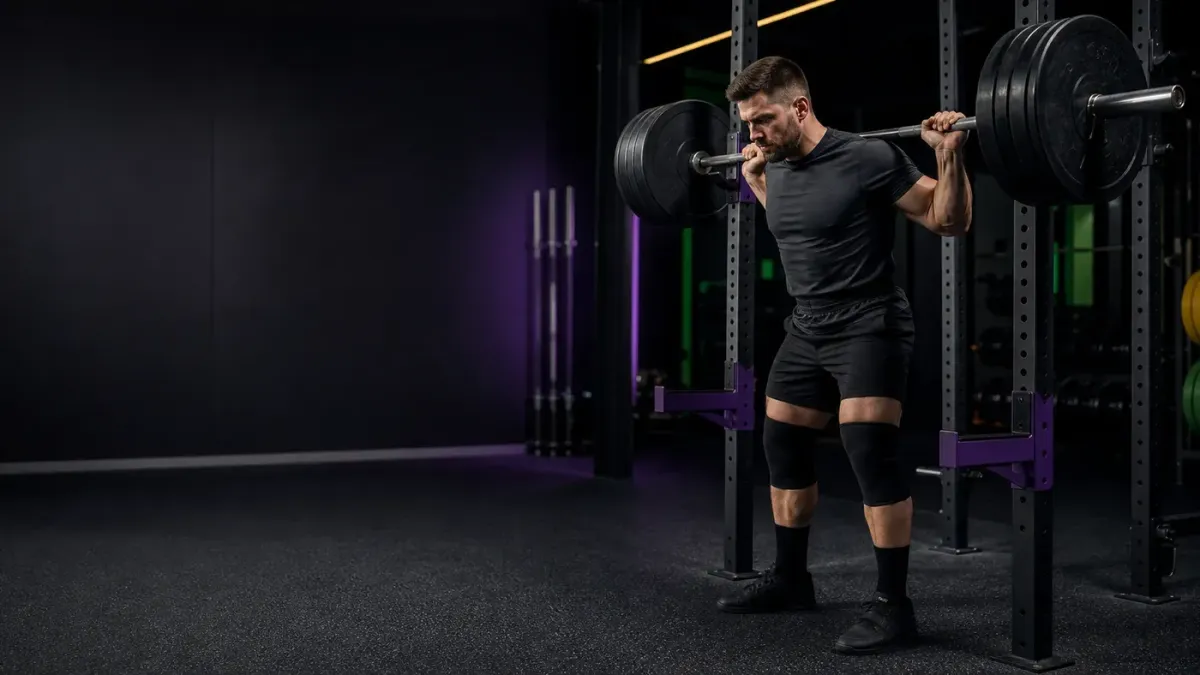
How Bracing Changes the Way You Perform a Lift
Bracing changes how well you can hold position and transfer force during a lift. It is not just tightening your abs or holding your breath. A useful brace coordinates breathing, pressure, and muscular tension so your torso can support what the rest of your body is trying to do.
That does not mean every exercise needs the same amount of pressure or the same breathing strategy. The brace used for a heavy squat should not automatically be copied into every cable exercise, machine movement, or lower-load exercise.
Bracing Is More Than Pulling Your Stomach In
When people are told to "brace your core," they often do one of three things:
- Pull the stomach inward as hard as possible
- Take a large breath only into the upper chest
- Create so much tension that they cannot move or breathe normally
Those strategies can make someone feel tight without necessarily putting them in a useful position.
A better brace usually begins with control of the rib cage and pelvis. From there, the lifter can breathe into the front, sides, and back of the trunk and create pressure against the abdominal wall. The goal is not to force one rigid posture on every person. The goal is to create enough pressure and stiffness for the task while keeping the position needed for the exercise.
Mechanistic studies during lifting and controlled tasks have measured higher intra-abdominal pressure as demand rises and found that pressure can contribute to trunk stiffness. Those studies do not establish one ideal strategy for every person or lift. They also do not prove that more pressure is always better or make bracing a guarantee against injury. They help explain why breathing and trunk strategy can change how stable and forceful a lift feels.
Position Comes Before Pressure
A large breath does not automatically create a good brace.
If the rib cage lifts and flares while the pelvis tips forward, the lifter may create a lot of tension while losing the position the exercise requires. The same thing can happen in the opposite direction when someone forces the ribs down and tucks the pelvis so hard that normal movement becomes difficult.
The useful position depends on the person and the lift. A squat, deadlift, overhead press, row, and split squat do not place the body in exactly the same situation. What should stay consistent is the sequence:
1. Establish the position needed for the exercise.
2. Breathe into that position.
3. Create the appropriate amount of pressure and tension.
4. Begin the repetition without immediately losing the setup.
This is one reason the setup matters. If position changes before the weight even moves, the body has to solve the repetition from somewhere other than the position you intended.
Heavy Lifts And Smaller Exercises Need Different Strategies
During a heavy squat or deadlift, a lifter may take a breath, create high pressure, and hold that pressure through the most demanding part of the repetition. A brief Valsalva maneuver can increase intra-abdominal pressure, but it also changes blood-pressure demands. Anyone with cardiovascular concerns or medical restrictions should follow guidance from an appropriate licensed professional.
That same high-pressure strategy is not always useful during a supported row, lateral raise, curl, or other smaller movement. In those exercises, the lifter may need enough trunk control to prevent unwanted movement while still being able to breathe through the set.
This is where breathing behind the brace becomes useful. Instead of completely relaxing between every breath, the lifter maintains the position and a useful level of abdominal tension while allowing smaller breaths. The goal is not to stay maximally tight. It is to keep enough control that breathing does not cause the entire setup to disappear.
What Poor Bracing Can Look Like During A Lift
Bracing problems are not always dramatic. They can show up as small changes that repeat across a set:
- The ribs lift before the repetition begins.
- The pelvis changes position as soon as force is produced.
- The lifter loses pressure at the hardest point of the repetition.
- Each repetition starts from a different position.
- The torso moves to create range that should come from somewhere else.
- The lifter can hold a position only by holding the breath indefinitely.
- A target muscle becomes harder to load as fatigue changes the setup.
None of these observations automatically identifies one cause. Load, fatigue, exercise selection, mobility, skill, and the intended technique all matter. Bracing is one part of the lift, not an explanation for every problem.
A Simple Way To Practice Bracing
Use a low enough load that you can pay attention to the sequence instead of fighting to complete the repetition.
1. Set the position. Organize the rib cage and pelvis for the exercise without forcing an exaggerated posture.
2. Take a controlled breath. Try to create expansion around the trunk rather than only lifting the chest.
3. Create tension before moving. Build the amount of pressure needed for the task before the repetition starts.
4. Use the right breathing strategy. A heavy compound lift may require a short breath hold. A longer or smaller exercise may require breathing while maintaining position.
5. Watch what changes under effort. The goal is not a perfect-looking repetition. It is to see whether the setup remains useful when the set becomes difficult.
Once the sequence is consistent at a manageable load, increase the demand gradually. Bracing should eventually support hard training. It should not become a reason to avoid effort.
Bracing Does Not Replace Training Intensity
Better setup and execution do not build muscle or strength by themselves. The set still needs sufficient effort, appropriate loading, progression, and recovery.
Most lifters need to learn to train harder, not use technique work as a reason to avoid difficult sets. The point of improving a brace is to make that effort more productive and repeatable. When the torso can support the intended position, it becomes easier to evaluate whether the target muscles are producing the work, whether the exercise fits the goal, and whether progress is actually happening.
Training hard and performing a lift well are not opposites. Better bracing should help the lifter keep useful position as the set becomes difficult, not turn every working set into a low-effort technique drill. Good coaching should help a lifter train hard and direct that effort where it is supposed to go.
That balance is part of the Strong Again coaching approach (https://scottydoocoaching.vip/#method): use position, execution, programming, and feedback to support productive effort.
Find The Limiting Factor Before Changing Everything
If your lifts feel unstable, your setup changes under load, or you cannot maintain position while breathing, bracing may deserve a closer look. It may also be exercise execution, movement control, recovery, or the structure of the program.
The Strong Again Movement Readiness Audit is a short starting point for identifying which training factor may be most relevant.
Take the Movement Readiness Audit (https://scottydoocoaching.vip/movement-readiness-audit)
Sources
- Harman EA, Rosenstein RM, Frykman PN, Nigro GA. Effects of a belt on intra-abdominal pressure during weight lifting. Medicine & Science in Sports & Exercise. 1989. (https://pubmed.ncbi.nlm.nih.gov/2709981/)
- Hodges PW, Cresswell AG, Daggfeldt K, Thorstensson A. In vivo measurement of the effect of intra-abdominal pressure on the human spine. Journal of Biomechanics. 2001. (https://doi.org/10.1016/S0021-9290(00)00206-2)
- Hackett DA, Chow CM. The Valsalva maneuver: its effect on intra-abdominal pressure and safety issues during resistance exercise. Journal of Strength and Conditioning Research. 2013. (https://pubmed.ncbi.nlm.nih.gov/23222073/)
